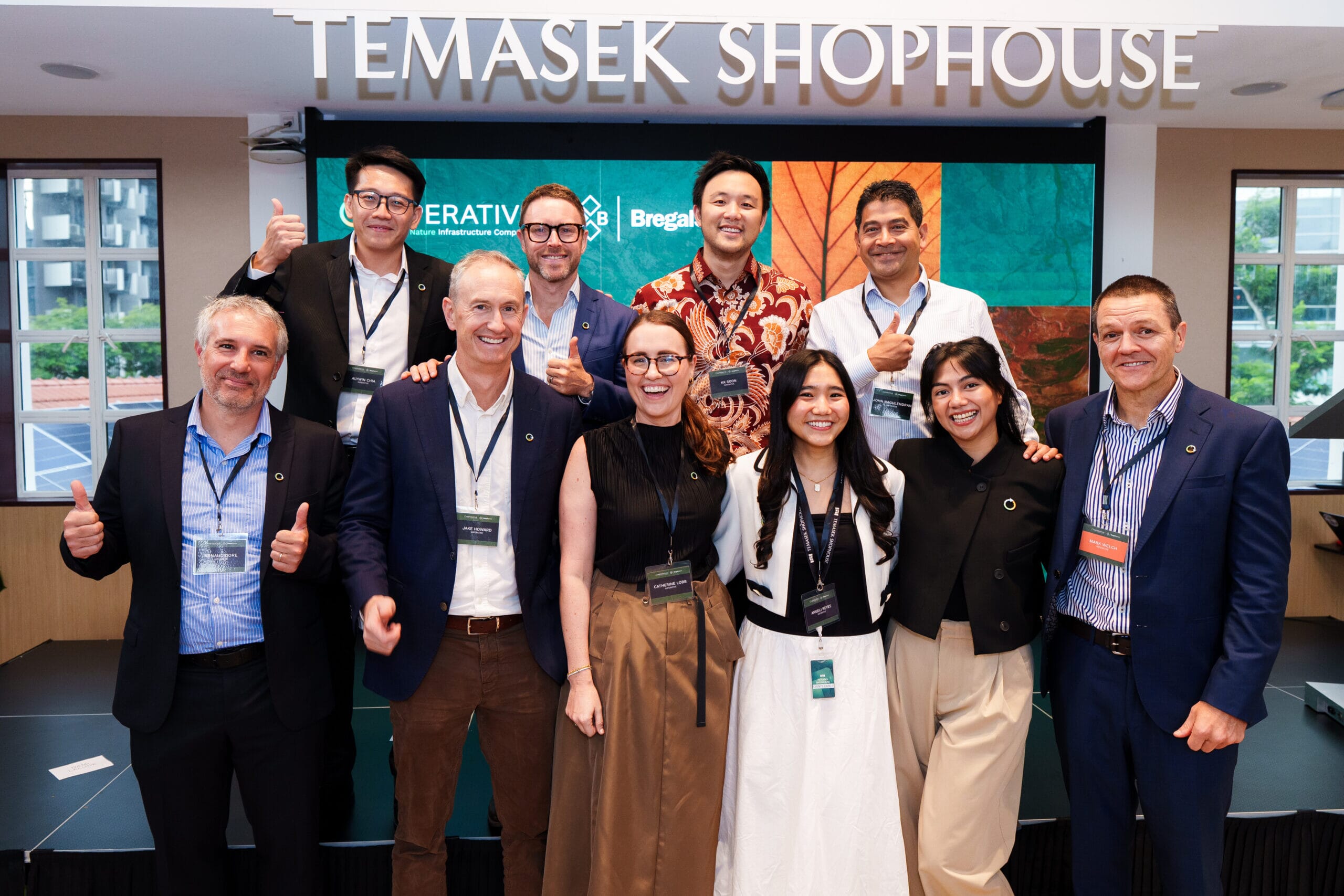

Singapore — 20 May 2026. During Ecosperity Week in Singapore, Imperative and Bregal Sphere co-hosted a panel discussion at the iconic Temasek Shophouse, built around a single question: what does it take to scale ecosystem restoration as institutional-grade infrastructure?
The session brought Imperative, together with its institutional investors GenZero, Mirova, Bregal Sphere and Rubicon Carbon alongside carbon ratings agency BeZero Carbon for an invigorating discussion, during which, several themes were explored:
Scale is not size for its own sake. As framed by moderator Dami Lalude of Bregal Sphere, scale is what unlocks everything else: the outcomes needed to address the climate challenge, the unit economics that make projects investable, and the institutional capital required to finance them.
Mark Welch, Imperative’s Chief Operations and Projects Officer, brought the argument back to economics. Drawing on two decades in LNG and major infrastructure, where plants have scaled from one million tones a year to twenty in pursuit of lower unit costs, he argued the same logic applies to restoration: “We don’t bring unit cost of production down only to increase returns. There is a direct link to quality. Getting to scale is what lets us deliver high-quality projects.” Lower unit cost funds better execution staff, quality control, data management and community engagement, the very things that make a project high quality in the first place.
The discipline transfers more directly than many expected. Welch pointed to two principles carried over from the built environment: pre-execution planning, where, by infrastructure benchmarks, roughly 80% of a project’s performance is determined before execution begins, and a formal risk-management framework that runs from early risk assessment through to schedules and cost estimates built to be predictable.
He was equally clear on where the analogy breaks. Nature introduces variables that cannot be locked down – weather, non-linear climate effects, and evolving relationships with communities. The objective is not to eliminate those variables but to limit them, and to respond quickly when something moves.
Asked about technology, Welch reframed the question around data: “We can always buy technology. We can never go back and create high-quality data, and without good data, technology is useless to us.” Real-time, well-structured operational data on productivity, safety, and more. This is what makes delivery predictable.
From the capital side, the panel was consistent on what gives institutional investors’ confidence. Mirova’s Charlotte Lehman and GenZero’s Rui Huang both pointed to governance and transparency: the quality of reporting, the willingness to surface problems early, and the structures that keep long-term alignment intact through to an eventual exit.
Huang noted that the Spekboom transaction’s streaming structure shares both risk and economics between private investors and the project, helping bridge the back-ended cash flows inherent to ARR projects.
Rubicon Carbon’s Flora Ji argued that the next era of the market will be defined by discipline, design, quality assurance, monitoring and remediation, observing that delivery risk today still sits largely with the financier, which makes that discipline non-negotiable.
BeZero Carbon’s Sebastien Cross added an infrastructure-financing reality check: debt finance, which is how infrastructure actually scales, tends to start at US$50–100 million ticket sizes, so a degree of scale, across a project or a portfolio, is a precondition for the cheaper capital the sector needs. On permanence, he was direct: a carbon project is an actively managed obligation, and nature can be kept permanent precisely because it is managed on an ongoing basis.
Closing the evening, Bregal Sphere’s Augustin Silvani described a “prove-it” moment for the sector, a still-small market building towards 2030, where performing portfolios and a demonstrated ability to return capital will matter when the next demand signal arrives. His verdict on the challenge ahead: hard, but eminently solvable.
Imperative, the Nature Infrastructure Company™, designs, develops, and operates large-scale ecosystem restoration projects across multiple jurisdictions. The company applies an infrastructure-grade approach to carbon removal — combining rigorous project engineering, vertically integrated operations, and institutional-quality standards to deliver high-integrity carbon credits with measurable biodiversity and community outcomes. Imperative’s projects are independently rated by BeZero Carbon and registered under Verra’s Verified Carbon Standard. For more information about Imperative, visit www.imperativeinc.com or follow on LinkedIn.
Bregal Sphere is an impact investing platform launched by Bregal Investments – a global investment firm managing over €19 billion AUM across multiple private markets strategies in North America and Europe. As a leading institutional natural capital investor, Bregal Sphere partners with leading nature-based project developers to deliver large-scale carbon removal projects that generate measurable positive impact for nature, climate, and local communities, alongside financial returns. For more information about Bregal Sphere, visit www.bregalsphere.com or follow on LinkedIn.